

Introduction
Proper filament care and storage is vital to maintaining the integrity and performance of 3D printing filaments. Neglecting these factors can lead to moisture absorption, brittleness, and contamination, resulting in failed prints, nozzle clogs, and wasted material. Whether you’re a hobbyist, designer, or engineer, adopting best practices ensures smooth printing experiences and maximizes the lifespan of your filaments.
This article explores the essentials of filament care and storage, including factors that impact quality, recommended solutions, and troubleshooting tips. By taking a few simple steps, you can ensure your filament remains in optimal condition, ready to bring your creative visions to life on your 3D printer.
1. Why Proper Filament Care and Storage Matter
Avoiding Print Failures
When filaments absorb moisture or degrade due to improper storage, they can produce poor-quality prints with visual imperfections, weak layer adhesion, or even bubbling. Storing filaments correctly prevents these issues and guarantees smoother extrusion.
Protecting Your Investment
High-quality filaments can be costly, and ensuring their longevity saves money in the long run. Proper storage minimizes material waste, allowing you to print more without replacing damaged spools prematurely.
Maximizing Performance
Filament quality directly influences the precision and functionality of 3D prints. Keeping materials in excellent condition ensures consistent performance, whether you’re working on prototypes, artistic designs, or technical components.
2. Factors That Affect Filament Quality
Several environmental factors can degrade the quality of 3D printing filaments over time. By understanding these influences, you can take proactive measures to preserve your materials and avoid common printing issues.
1. Humidity
One of the most critical threats to filament quality is moisture absorption. Many filaments, such as PLA, Nylon, and PVA, are hygroscopic, meaning they readily absorb water from the air. Moisture-laden filaments can cause issues like bubbling, stringing, and poor layer adhesion during printing.
Example: A spool of Nylon filament left exposed in a humid room may absorb enough moisture to cause prints with surface imperfections and weakened mechanical properties.
2. Temperature
Exposure to high temperatures can lead to filament degradation, especially for materials like PLA and PETG. Over time, heat can cause these materials to lose structural integrity, making them brittle and unusable.
Example: Leaving a filament spool in direct sunlight or near a heat source, such as a radiator, can cause warping or uneven extrusion during printing.
3. UV Exposure
Filaments like PLA and ABS are sensitive to ultraviolet (UV) light, which can weaken and discolor the material. Prolonged exposure to sunlight can accelerate filament aging, reducing its effectiveness.
Example: Storing filament spools on a windowsill can result in faded or brittle material, leading to reduced print quality.
4. Dust and Contamination
Dust particles and other contaminants can settle on exposed filaments, leading to clogs in the printer nozzle and inconsistent extrusion. Keeping spools clean and covered is crucial to maintaining print quality.
Example: An uncovered spool stored in a workshop may accumulate sawdust or debris, causing interruptions and imperfections during printing.
Why These Factors Matter
Recognizing how humidity, temperature, UV light, and contamination impact filaments allows you to implement proper storage techniques. Preserving filament quality ensures smooth, precise prints and reduces the risk of wasting material on failed projects.
3. Best Practices for Storing Filaments
Proper storage is the cornerstone of maintaining the quality and performance of your 3D printing filaments. By adopting these practices, you can protect your materials from environmental damage and ensure consistent printing results.
1. General Tips for All Filaments
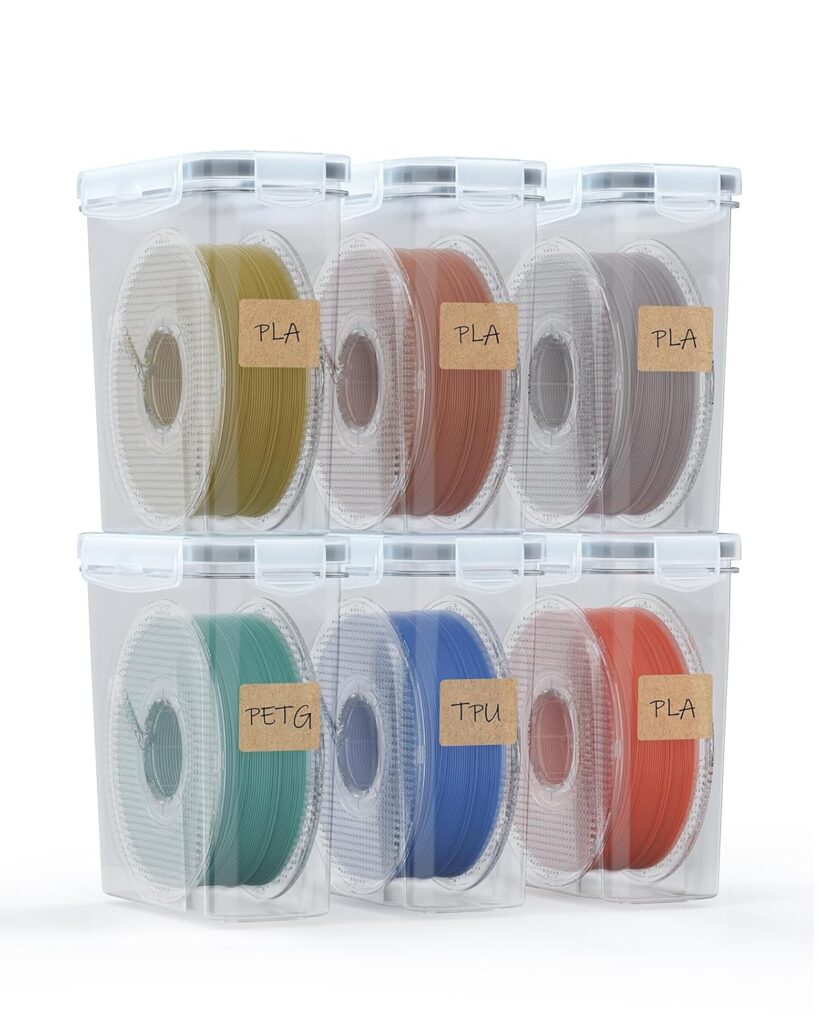
- Use Airtight Containers: Store filaments in airtight containers or vacuum-sealed bags to shield them from moisture and contaminants. Incorporate silica gel desiccant packs to absorb any residual humidity.
- Keep Spools Labeled: Clearly label each filament spool with its material type, purchase date, and any specific storage recommendations from the manufacturer. This prevents mix-ups and helps manage older stock.
- Avoid Sunlight and Heat Sources: Place containers in cool, shaded areas away from direct sunlight, radiators, or other heat sources to prevent filament degradation.
2. Tailored Advice for Specific Filaments
PLA and PETG
- Storage Need: These are less sensitive to moisture but still benefit from a cool, dry environment.
- Tip: Use standard airtight boxes with a desiccant pack to prolong their lifespan.
Nylon and PVA
- Storage Need: Highly hygroscopic materials like Nylon and PVA require humidity-controlled environments.
- Tip: Invest in a filament dry box or use sealed containers paired with rechargeable desiccants.
Flexible Filaments
- Storage Need: Prevent tangling, which can damage the material and disrupt prints.
- Tip: Secure the loose end of the filament spool after every use and avoid tight bends when storing.
Conductive Filaments
- Storage Need: Moisture exposure can compromise electrical conductivity.
- Tip: Use airtight containers with an emphasis on humidity control.
Carbon Fiber and Flame-Retardant Filaments
- Storage Need: Sensitive to moisture and dust.
- Tip: Keep these materials in sealed, dust-free containers to prevent contamination that could damage printer nozzles.
Why Best Practices Matter
By tailoring your storage methods to specific filament types and maintaining a clean, controlled environment, you can prevent common issues like moisture absorption, tangling, or brittleness. These small steps ensure your materials are always ready for high-quality prints.
4. Filament Care and Storage Solutions
There are various storage solutions available to preserve filament quality, ranging from DIY approaches to specialized commercial products. Whether you’re a hobbyist with a few spools or a professional managing an extensive inventory, these options help protect your materials from environmental damage.
DIY Storage Solutions
- Airtight Plastic Containers:
- Use large, resealable plastic bins to store multiple filament spools. Add silica gel packets to control humidity.
- Tip: Label the containers with the type and quantity of filaments inside for easy organization.
- Vacuum-Sealed Bags:
- For an affordable and effective solution, vacuum-seal individual filament spools with desiccant packs.
- Tip: Use manual or electric vacuum sealers designed for food storage.
- Repurposed Household Items:
- Reuse airtight jars or zippered plastic bags to store smaller filament spools or scraps.
- Tip: Ensure these items are clean and moisture-free before use.
Commercial Storage Products
- Filament Dry Boxes:
- Designed to maintain a controlled low-humidity environment, these boxes keep sensitive materials like Nylon and PVA in optimal condition.
- Examples: eSun’s eBox or SUNLU Dry Box.
- Best For: Moisture-sensitive filaments.
- Heated Storage Units:
- These devices combine low-humidity storage with gentle heat to dry filament while it’s being stored.
- Best For: High-temperature or industrial-grade materials like PEEK and PEI.
- Specialized Filament Cabinets:
- Purpose-built cabinets with climate control features offer organized, large-scale storage solutions.
- Best For: Professional setups or labs managing extensive filament inventories.
Humidity-Controlled Storage
- Silica Gel Packs:
- Place a few silica gel packets inside containers to absorb moisture. Rechargeable desiccants are a convenient, reusable option.
- Tip: Change packets regularly to ensure ongoing effectiveness.
- Dehumidifiers:
- Use small dehumidifier units in filament storage areas to maintain a low-humidity environment.
- Best For: Regions with consistently high humidity.
Choosing the Right Solution
- Hobbyists: Use vacuum-sealed bags or airtight containers for a compact and cost-effective setup.
- Small Businesses: Invest in filament dry boxes to store and condition moisture-sensitive materials.
- Large-Scale Users: Opt for climate-controlled cabinets to manage and protect multiple spools simultaneously.
Why filament Care and Storage Solutions Matter
Selecting the right storage option ensures your filaments remain in top condition, ready to deliver consistent, high-quality prints. By tailoring your approach to your specific needs and materials, you can prevent unnecessary waste and frustration.
5. How to Maintain Filaments During Printing Breaks
Filament care doesn’t end with proper storage—short breaks between print jobs require special attention to prevent tangling, brittleness, or moisture absorption. Here’s how to keep filaments in excellent condition during these pauses.
1. Tips for Short-Term Breaks
If you’re pausing printing for a few hours or days, follow these quick steps to protect your filament:
- Secure the Spool End: Always clip the filament’s loose end securely to the spool to prevent tangling. Many spools come with built-in holes or clips for this purpose.
- Cover the Printer: If the filament remains loaded in the printer, use a dust cover to protect both the spool and the machine from contamination.
- Use a Dry Box: Store the spool in a filament dry box or an airtight container near the printer to avoid reloading hassles.
2. Managing Longer Pauses (Weeks to Months)
If your printer will be idle for an extended period, take additional measures to ensure the filament’s quality:
- Unload Filament from the Printer: Remove the filament from the extruder and spool it neatly. This prevents nozzle clogs and keeps the material from deforming at the printer’s heat zone.
- Repackage the Filament: Place the spool back into an airtight container or vacuum-sealed bag with fresh desiccant packs to maintain low humidity levels.
- Inspect Before Storing: Check for signs of brittleness or moisture absorption, such as uneven texture or snapping under gentle stress.
3. Reconditioning Filament After Storage
If a filament has been in storage for a prolonged period, you may need to recondition it before printing:
- Dry the Filament: For moisture-sensitive filaments, use a filament dryer or a specialized low-temperature oven to remove any absorbed moisture.
- Example: Nylon and PVA can benefit from drying at 60°C–70°C for several hours.
- Test for Printability: Before starting a large print job, test the filament with a small print to identify any potential issues, such as inconsistent extrusion or bubbling.
Why Maintenance During Breaks Matters
Properly handling filaments during breaks ensures that they remain ready for use and prevents the frustration of failed prints or unnecessary material waste. By incorporating these habits into your workflow, you’ll maximize the lifespan and performance of your 3D printing filaments.
6. Troubleshooting Common Filament Care and Storage Related Issues
Even with proper filament care and storage, issues can still arise that affect filament performance. Here are common problems related to storage, along with practical solutions to get your filaments back in working order.
1. Moisture Absorption
Symptoms:
- Bubbling or hissing sounds during extrusion.
- Weak layer adhesion and surface imperfections.
Solution:
- Dry the Filament: Use a filament dryer, dehydrator, or low-temperature oven (set to around 50°C–70°C) to remove absorbed moisture.
- Prevent Future Issues: Store the filament in airtight containers with silica gel or in a dedicated filament dry box.
2. Brittleness
Symptoms:
- Filament breaks easily when unspooled or handled.
- Poor tensile strength in printed parts.
Solution:
- Recondition the Filament: For materials like PLA, slightly warming the filament in a controlled environment (e.g., a filament dryer or an oven at low temperature) can restore some flexibility.
- Evaluate Usability: Severely brittle filaments may be beyond repair and should be replaced.
3. Tangling
Symptoms:
- Filament unwinds unevenly, causing knots or printing pauses.
- Spool gets stuck during extrusion.
Solution:
- Untangle the Spool: Manually unravel and rewind the filament evenly, ensuring the spool end is clipped or taped securely to avoid future tangling.
- Prevent Future Issues: Always secure the loose filament end after use and avoid placing spools where they can unwind accidentally.
4. Dust and Contaminants
Symptoms:
- Nozzle clogs during printing.
- Visible debris on the filament.
Solution:
- Clean the Filament: Run the filament through a soft microfiber cloth or filament cleaner before loading it into the printer.
- Prevent Future Issues: Store spools in covered or airtight containers to prevent exposure to dust and debris.
5. Deformation
Symptoms:
- Filament appears flattened, warped, or melted in certain areas.
- Uneven extrusion or nozzle clogs during printing.
Solution:
- Cool Down the Spool: If deformation is caused by heat, allow the filament to cool fully. Unfortunately, heavily warped filaments may be unusable.
- Prevent Future Issues: Avoid storing filaments near heat sources or in direct sunlight.
6. Loss of Conductivity (For Conductive Filaments)
Symptoms:
- Reduced or no electrical conductivity in printed parts.
Solution:
- Inspect and Test: Moisture or dust can degrade the properties of conductive filaments. Dry and clean the material thoroughly before use.
- Prevent Future Issues: Store conductive filaments in airtight containers with desiccant packs.
Why Troubleshooting Matters
Understanding how to identify and resolve storage-related issues can save you time and money by reducing failed prints and wasted materials. By implementing preventative measures, you’ll maintain the quality and reliability of your filaments for longer periods.
7. FAQs About Filament Care and Storage
Addressing common concerns can help users better understand how to store and care for their 3D printing filaments effectively. Here are answers to frequently asked questions.
1. General Filament Storage Questions
Q1: How long can filaments be stored without damage?
If stored correctly (e.g., in airtight containers with desiccants), filaments can last for years. Moisture-sensitive materials like Nylon or PVA should be checked regularly to ensure they remain dry.
Q2: Can I store filament spools in their original packaging?
Yes, but only if the packaging is airtight or contains a desiccant. For long-term storage, transferring filaments to vacuum-sealed bags or dry boxes is recommended.
2. Moisture and Humidity Concerns
Q1: How can I prevent filaments from absorbing moisture?
Store filaments in airtight containers or dry boxes with silica gel packets. Avoid storing them in humid environments, such as basements or bathrooms.
Q2: Can moisture-damaged filaments be salvaged?
Many moisture-damaged filaments can be dried using a filament dryer, dehydrator, or low-temperature oven set between 50°C–70°C.
3. Compatibility and Special Materials
Q1: Are filament dry boxes compatible with all materials?
Yes, dry boxes work for most filaments, especially hygroscopic ones like Nylon and PVA. They also help maintain general material quality for PLA, PETG, and ABS.
Q2: Do conductive filaments require special storage?
Yes, conductive filaments are sensitive to moisture and dust. Airtight containers with desiccant packs are ideal for preserving their properties.
4. Short-Term Care
Q1: Can filaments be left loaded in the printer?
Yes, but only for short periods and in a clean, dust-free environment. Use a printer cover and secure the loose spool end to prevent tangling.
Q2: How can I recondition filaments stored for a long time?
Dry the filament using a dryer or oven and test its printability with a small project before committing to larger prints.
Why FAQs Are Important
Clear answers to common questions empower users to take proactive steps in filament care and storage, ensuring optimal printing experiences and minimizing frustration caused by damaged materials.
8. Conclusion
Proper filament care and storage of 3D printing materials are fundamental to achieving consistent, high-quality results and prolonging the lifespan of your materials. By taking proactive measures—such as controlling humidity, avoiding heat and UV exposure, and investing in airtight storage—you can safeguard your filaments from common issues like moisture absorption, brittleness, and contamination.
Key Takeaways
- Prevention Is Key: Protecting filaments from environmental damage reduces the risk of print failures and material waste.
- Tailored Storage: Each filament type requires specific care to ensure optimal performance, from flexible materials to moisture-sensitive options like Nylon.
- Practical Solutions: Simple steps, like using silica gel packs or filament dry boxes, make a significant difference in maintaining material quality.
Final Thought
Filaments are the foundation of every 3D printing masterpiece. By dedicating a little time and effort to their care, you ensure that your creative ideas can come to life without unnecessary interruptions or frustrations. Whether you’re printing for fun, work, or innovation, well-stored filaments keep your projects running smoothly and brilliantly.
